


10 unique places in Europe to add in your #bucketlist
- FYI

- Aug 11, 2020
- 4 min read
1. Tinto River, Spain

Tinto in Spanish means Red, this river rises from southern west Spain Sierra Morena mountains of Andalusia. Its unique red and orange color which attracts the uniqueness of nature. The river is in the area for centuries a mine of copper, gold, and other metals. After that many years of mining high levels of iron dissolved in the river which resulted in making the water extremely acidic.
2. Vipava Valley, Slovenia

Vipava Valley, Slovenia is a place for nature lovers & one of the best-hidden gems of Ljubljana. Its slow lifestyle, it's authentic the century looks makes a perfectly suitable place for a long weekend for cycling or hiking or any activities.
Apart from its heritage, culture, and lifestyle, this place is also famous for mass graves.
3. Monastery of the Holy Trinity, Greece

This Place is also known as Agia Triada, Ayías Triádhos, Ayia Triada which means “Holy Trinity”. It is situated in Meteora, Kalambaka, Greece. These cliffs are from the 11th Century and its old heritage look & ethnicity makes it more interesting and giving it the best look. This church has been included in World Heritage Sites by UNESCO titled “Meteora”.
4. Queen Maeve’s Grave, Knocknarea, County Sligo

Knocknarea, the name itself comes with plenty of different approaches to it. The Placement of Database of Ireland gave this an Irish name as Cnoc na Riabh (Hill of Stripes), However P.W. Joyce, an Irish historian interpretation Cnoc na Riaghadh (Hill of the executions). Apart from these, some have also suggested names as Cnoc na Riogha (Hills of the Kings, Cnoc na Ré (Hills of the moon), etc.
It is a 30ft pile of rocks, which is said to be a grave of a mythological the fiery Irish queen Medb. This place is also famous for hiking. This place can be visited by anyone, although to preserve the natural beauty of the tomb, the visitors are asked not to climb on the cairn and not to collect any stones from the said place.
5. Kjeragbolten, Norway

Kjeragbolten is a mountain in Rogaland, Norway. This place is a tourist attraction for its beautifully and naturally placed stone in a 5-cubic-meter (180 cu ft) glacial deposit wedged in the mountain's crevasse.
It was rediscovered by traveler Matt Harding, who danced on the top of this precarious boulder which gathered a good amount of attention. It is always open for local tourists & one can expect a waiting time there.
6. Leonardo Da Vinci's Bridge, Akershus, Norway
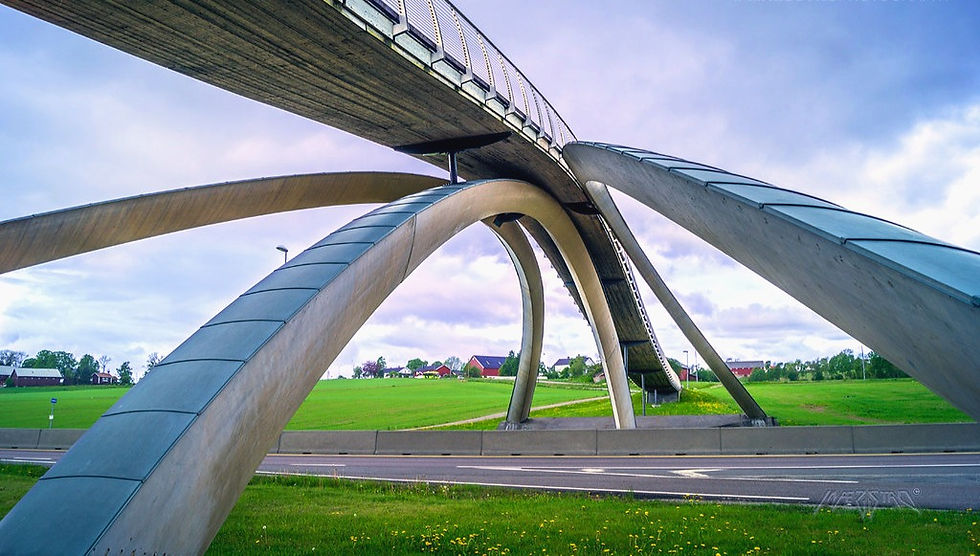
Leonardo Da Vinci's Bridge was built on European route E18 in 2001, this laminated-wood parabolic-arch pedestrian bridge was first proposed by Leonardo da Vinci in 1502, which was later rediscovered in 1952. It is approximately 20kms from Oslo.
It is one of the beautiful and must-see bridges in Norway.
7. Hofburg Palace, Austria

Hofburg Palace is located in the center of Vienna and was built in the 13th century. It includes various residences, imperial chapel, library, treasury, Burgtheater, Riding schools, and mews. It is been used as the seat of the head state & Austrian Federal President.
Its one of the must-see, places when in Vienna.
8. Skellig Michael, Ireland

Skellig Michael, which is also known as Great Skellig, is the larger of two islands located 7.2 miles west of the Iveragh Peninsula in Country Kerry, Ireland The smaller of the two islands is known as Little Skellig. (The name ‘Skellig’ comes from the word Sceillic, which means a steep rock.)
The island was dedicated to Saint Michael the Archangel sometime before 1044 when the death of ‘Aedh of Scelic-Mhichíl’ was recorded.
The island is known for its seabird colonies, and, combined, the two Skellig islands comprise one of the most important seabird sites in Ireland.
Skellig Michael is an attraction point for all archaeologists due to its uncanny surroundings, stones, rocks, bays, etc. To prevent the protection of the place & tourists the office of public works gives 180 visitors permits to visit per day. The best climate to visit this place is in summer.
9. Crooked Forest, Poland
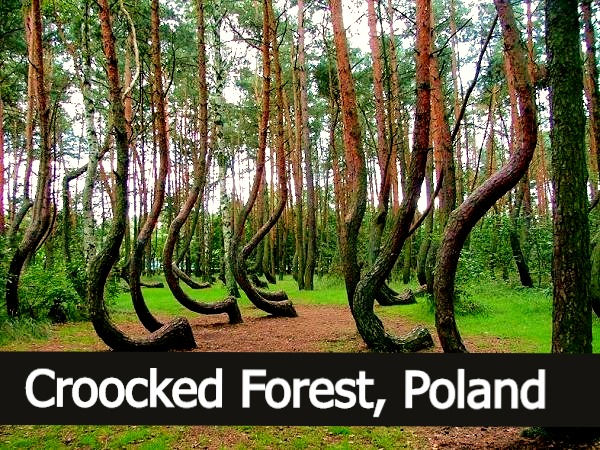
Krzywy las or Crooked Forest found near the town of Gryfino near the Polish and German border. The mysterious forest which was formed in 1930, consists of 400 unusually shaped pine trees that almost look like a letter “J”.
Many theories about the Forest’s existence:
One of the hypothesis says that the local foresters moulded the pine trees to make barrels, sleds and ships easier.
Other theory suggests, the German army which invaded Poland in 1939, shaped and bent those trees so intensely that they started to grow in a weird angle.
Our personal favourite states that the trees were distorted by the ufo that landed in this particular area of the forest.
Some say that force of heavy snowfall weighed down the growing trees, due to which trees develop oddly at the base, but this does not answer why other pine trees and various vegetation in the same locality were not affected.
Some theories states, the Northward curves are due to a gravitational pull in this specific region however this theory does not support the basic science law according to which gravity pulls things down and not at a curve.
In spite of several theories, the mystery about how and why these trees were bent still remains.
10. St. Michan’s Mummies, Dublin

St. Michan’s Church, which is also known as Anglican Church, the first Christian chapel on that site from 1095. It holds the mummified remains of some of Ireland’s very influential families from the 17th to 19th centuries.
This particular church open to tours on Saturdays for the general public & tourists.
#Europe #europetraveling #travel #travel #austria #vienna #germany #belgium #norway #ireland #historic #places #world #planet #heaven #strange #weird #spain #unusual #supernatural #haunted #mystery #mysterious #slovenia #dublin #ireland #greece #poland #skellingmichael
#michan #mummy #crookedforest #hofburg #palace #leonardo #davinci #bridge #akershus #tinto #river #vipava #valley #monastery #mummy #crookedforest #bucketlist #hofburg #palace #leonardo #davinci #bridge #akershus #tinto #river #vipava #valley #monastary #holy #trinity #kjerabolten #didyouknow


Comments